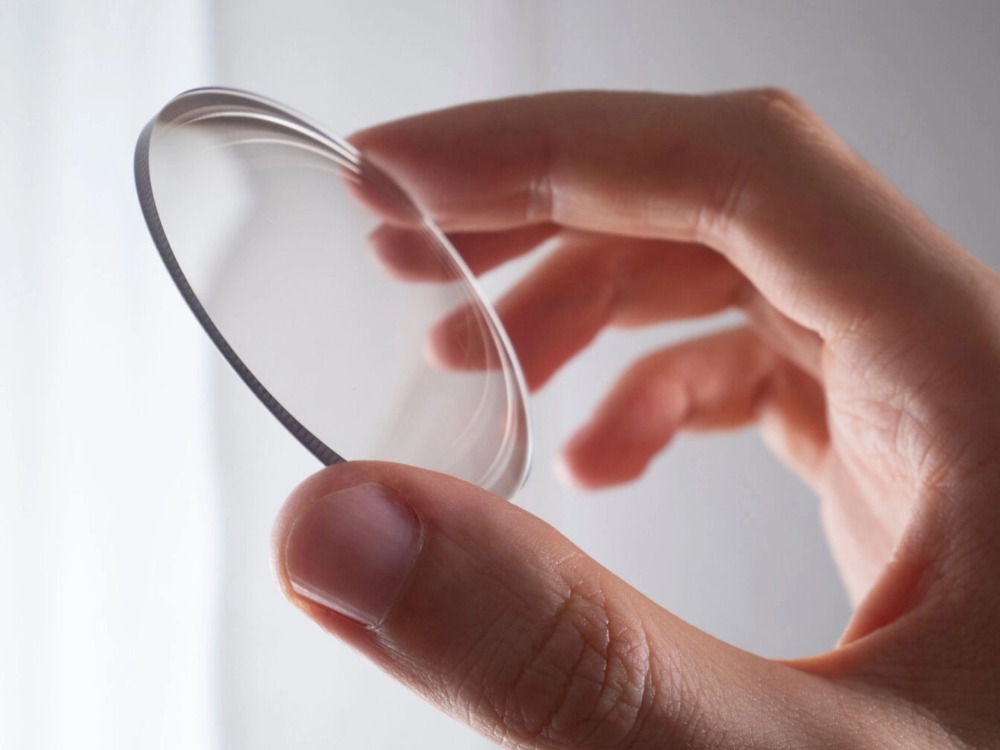
Prescription lenses correct blurry vision by bending light rays so they focus precisely on the retina at the back of your eye, correcting the shape mismatches that cause refractive errors.
How Normal Vision Works
Light enters the eye and is refracted by the cornea and natural lens, and is focused into a sharp point on the light-sensitive retina, which sends visual signals to the brain. Perfect vision occurs when this focal point lands exactly on the retina.
Common Refractive Errors
Refractive errors happen when the eye’s shape prevents light from focusing correctly:
- Myopia (nearsightedness): The eyeball is too long or the cornea too curved, so light focuses in front of the retina. Distant objects appear blurry.
- Hyperopia (farsightedness): The eyeball is too short or the cornea too flat, so light focuses behind the retina. Close objects appear blurry.
- Astigmatism: An uneven, rugby-ball shaped cornea creates two focal lines instead of a single point, causing distorted vision at all distances.
How Lenses Correct Each Issue
Each vision problem uses a specific lens shape to redirect light onto the retina:
- Myopia: Corrected with concave (minus) lenses — thinner in the center, thicker at the edges. They spread incoming light to shift the focal point backward onto the retina.
- Hyperopia: Corrected with convex (plus) lenses — thicker in the center, thinner at the edges. They concentrate light to shift the focal point forward onto the retina.
- Astigmatism: Corrected with cylindrical lenses, which have power along one specific axis to cancel out the uneven corneal curve and form a single clear focal point.
What Prescription Numbers Mean
Lens power is measured in diopters (D). Minus values correct myopia, plus values correct hyperopia. Higher numbers mean stronger correction; even a 0.25 D change affects perceived clarity.
Why Proper Fit Matters
For lenses to work correctly, their optical center must align exactly with your pupils (measured as pupillary distance, or PD). Misaligned frames cause blurriness and eye strain, so professional fitting is just as important as an accurate prescription.
Final Takeaway
Prescription lenses are custom optical tools matched to your eye’s unique shape. Combined with a well-fitted frame, they precisely compensate for refractive errors to deliver clear, comfortable vision.