If you’ve ever had an eye exam, you’ve probably heard the terms myopia, hyperopia, and astigmatism. These are the three most common refractive errors - vision problems caused by the shape of your eye that make light focus incorrectly on the retina. Below we break down what each condition is, how it affects your vision, and how it’s corrected.
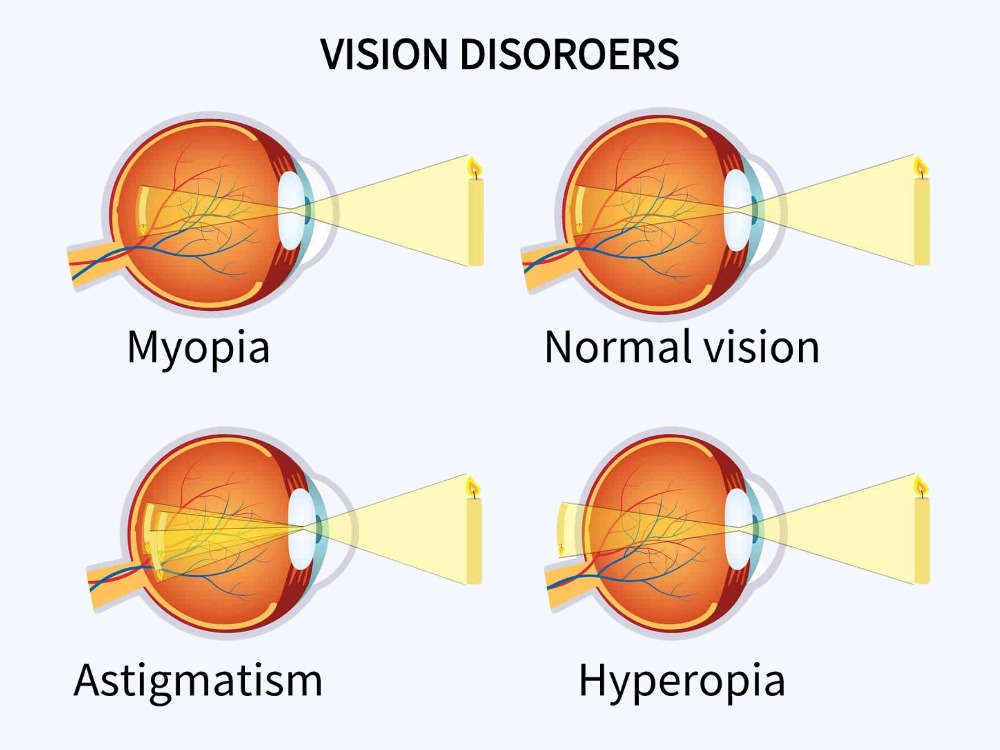
Myopia
Myopia, commonly called nearsightedness, is a condition where close objects look clear but distant objects appear blurry. It develops when the eyeball grows too long, or the cornea is overly curved, so light focuses in front of the retina instead of directly on its surface. It typically begins in childhood and may progress through the teenage years. People with myopia often squint to make out faraway signs, screens, or road markings, and may experience eye strain or headaches from straining to see at distance. It is corrected with concave, minus-power lenses.
Hyperopia
Hyperopia, also known as farsightedness, means distant objects appear clearer than close-up ones — though severe hyperopia can cause blurriness at all distances. It occurs when the eyeball is too short, or the cornea is too flat, so light lands behind the retina rather than precisely on it. Many people are born with mild hyperopia, and some children outgrow it as their eyes develop. Common symptoms include blurry near vision, tired eyes after reading or screen use, and headaches from prolonged close work. It is corrected with convex, plus-power lenses.
Astigmatism
Astigmatism causes blurry or distorted vision at every distance, not just far or near. It happens when the cornea - the clear front layer of the eye - is shaped unevenly, more like a rugby ball than a perfectly round basketball. This irregular curve makes light focus at multiple points on the retina instead of one single sharp point. Astigmatism often occurs alongside myopia or hyperopia. Typical symptoms include fuzzy vision at all ranges, eye strain, frequent headaches, and trouble with night vision. It is corrected with cylindrical lenses that match the uneven curvature of the cornea.
Conclusion
All three are common refractive errors, not eye diseases - they are simply natural differences in eye shape that alter how light focuses. All three can be corrected with glasses, contact lenses, or refractive surgery for eligible candidates. A comprehensive eye exam is the only way to get an accurate diagnosis and a prescription tailored to your vision.