
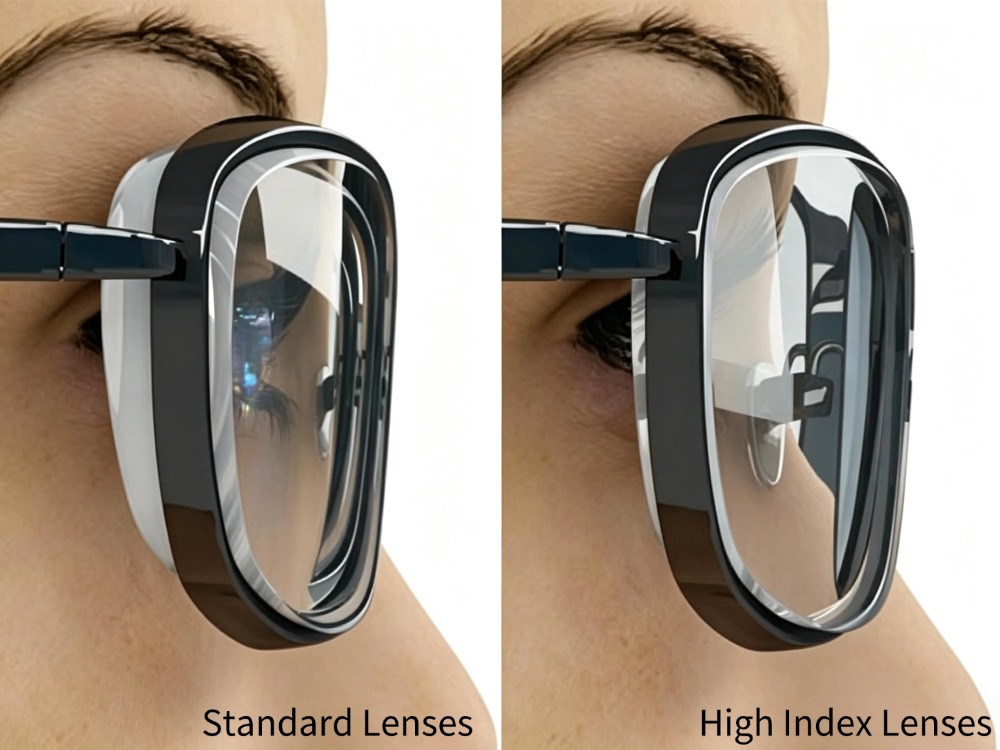
High-index lenses use advanced materials that bend light more efficiently than standard plastic, so much less material is needed for the same vision correction.
The core science: Refractive index
The refractive index measures how strongly a material bends light. Standard plastic is around 1.56 and 1.61; high-index materials range from 1.67 to 1.74. Because high-index materials do more of the light-bending work themselves, the lens can be made flatter and thinner while correcting vision perfectly.
Where the thickness reduction appears
- For myopia (nearsightedness), the thickest part is the edge — high-index mainly slims the outer rim.
- For hyperopia (farsightedness), the thickest part is the center — high-index reduces center bulge.
Upgrading from 1.56 to 1.67 typically cuts thickness by roughly 20-30% or more, with even greater reductions for higher prescriptions.
For the same lens index, higher prescription means thicker lens. For the same prescription, higher lens index means thinner lens.
Important tradeoffs
- Mild color dispersion: High-index materials often have a lower Abbe number, which can produce faint color fringing around bright objects.
- Higher cost: More precise manufacturing makes high-index lenses more expensive.
Who benefits most
- Medium to high prescriptions (±3.00D and above)
- Those wanting a slimmer, less noticeable lens appearance
- People who prefer larger frames
For low prescriptions (under ±2.00D), the thickness difference is minimal, so standard lenses offer better overall value.
Final takeaway
High-index lenses replace steep, thick curves with smarter light-bending materials. They are a targeted upgrade for higher prescriptions, not a universal need.